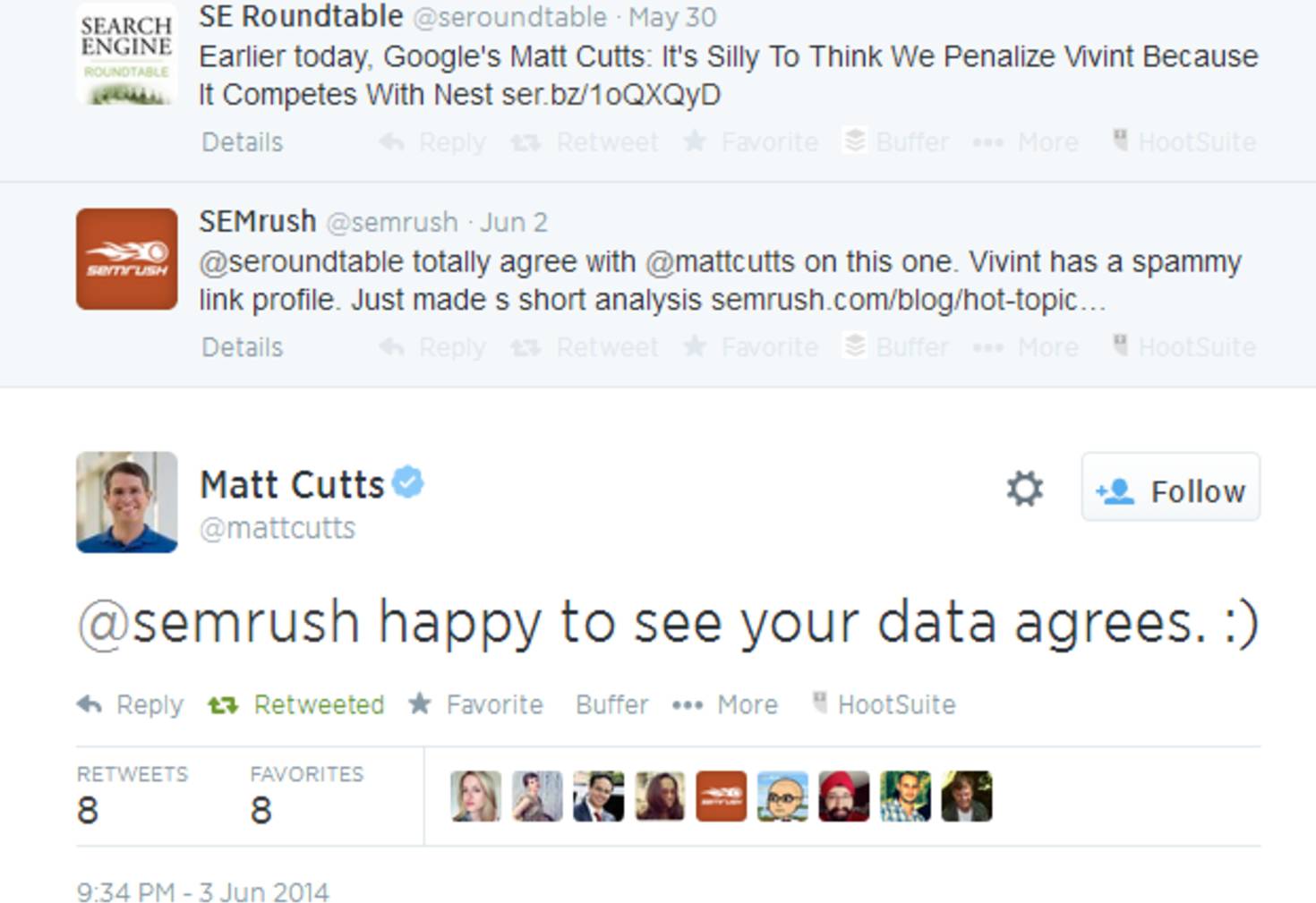
Matt Cutts and the Magic Tweet
One Tweet can make a world of difference. We needn’t touch on current US politics to make this case.
In June of 2014, a significant portion of my work product was opportunistically invested in helping domains recover from a series of Google Algorithmic Updates and filters and penalties. SEOs were shell-shocked from all of the plate tectonics shifts that had shaken SEO to its foundations.
In rapid succession, we’d successfully risen above Penguin, Panda, Hummingbird, the expanding Knowledge Graph, Phantom, quality updates, over-optimization penalties, top-heavy ad-intensive designs.
“Not provided” (the deliberate obfuscation of click-inducing keywords in one’s Analytics), in particular, had shaken SEO to its very foundations. Associating high-performing keywords with particular pages had become a chore, and data tools with massive crawl rates were becoming Optimizer’s best friends.
I personally felt very fortunate to have moved from digital agency consultant to become the US Marketing Director for one of the best-known such tools, SEMrush. But, I also felt like a big crosshairs was painted on me, and my co-workers.
“What if Google knows what we’re doing?” employees and subscribers would whisper, “they could crush us in an instant!”
I was convinced that Google knew full well of the data that SEMrush and others shared. My rationalization was, “Google must be aware, and has already chosen to look the other way.”
Also, evidence existed that SEMrush data fueled the addition of working keywords to many AdWords and AdSense Campaigns, helping to boost Google revenues. “Why would Google knowingly decimate such a partner?” helped soothe my jangled nerves. But, the industry trepidation continued, unabated.
Finally, Matt Cutts reached out with what appeared to be a casual response to the tiniest bit of rumor-busting that SEMrush engaged in. And that changed everything.
The controversy was the widely disparate treatment of home automation manufacturers in Google SERPs. Conspiracy theorists presented arguments that since Vivint rankings suffered for the same keywords for which Google’s own Nest device appeared on page one, Google was manipulating the visibility, and using their search might to unfair business advantage.
Google’s reputation was not spotless, and they had engaged in some spam themselves, but this was not the case in this instance. A quick review of Vivint’s link profile was enough to reveal to the trained eye that high-volume, spammy linkbuilding practices had accumulated vast numbers of toxic backlinks in their link graph. This was reason enough for any pages to be relegated to the purgatory of ‘page three and beyond”.
SEMrush rode the industry news trend with that insight, and Matt Cutts noticed our blog being fair (instead of what was often a condemnatory tone, taken by guest authors) and acknowledged that we were, for once, in alignment. To me, that message carried three very important points:
1) Google knew all about us and chose not to squish us
2) Matt Cutts was a gentleman and had an ironic sense of humor
3) Our PR and publishing needed to mature and support the larger search industry
I shared that Tweet with many, on a private basis, to quell the doubts of the most fearful. It signaled cooperation when many insisted that SEO toolsets were all going to die a horrible death at the hands of the largest and most powerful search engine. I am grateful for the hope it gave to those busily developing a future symbiotically (some might say, parasitically) tied to an economic engine called Search.